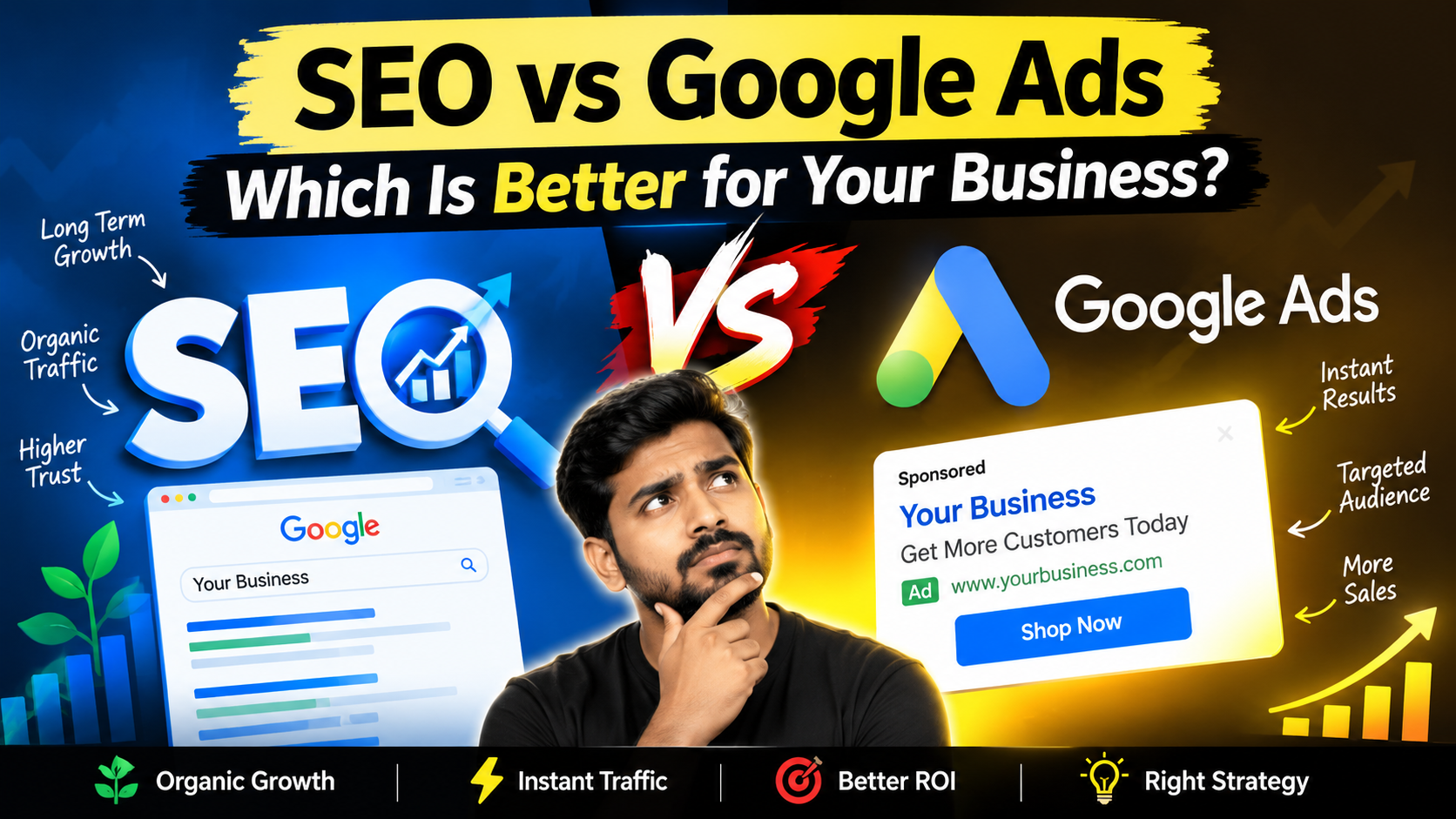
SEO vs Google Ads : Discover which strategy is better for your business, compare costs, ROI, results, and learn when to use SEO, Google Ads, or both.
If you own a business, there is a good chance you have asked this question:
“Should I invest in SEO or Google Ads?”
It sounds like a simple question.
With SEO, you work toward earning visibility in Google’s organic search results. With Google Ads, you pay to participate in advertising auctions and potentially show your ads when people search for relevant products or services.
The real question, therefore, isn’t simply:
SEO vs Google Ads — which one is better?
The better question is:
“Which strategy is better for my business, my budget, my customer journey, and my growth goals?”
For one business, SEO may be the foundation of long-term growth. For another, Google Ads may be the fastest way to generate qualified enquiries. For many businesses, the most practical approach is to use SEO and Google Ads together, with each channel doing a different job.
In 2026, this distinction is even more important because search behaviour, advertising automation, AI-powered advertising systems, and the way users discover information continue to evolve.
Google’s own documentation emphasizes following Search Essentials, technical requirements, spam policies and people-focused search practices for organic visibility.
At the same time, Google Ads increasingly uses AI-powered systems such as Smart Bidding to optimize bids around conversions or conversion value.
So instead of treating SEO or Google Ads as an either/or decision, businesses should understand what each channel can realistically accomplish.
And that is exactly what this guide will explain.
Table of Contents
- What Is SEO?
- What Are Google Ads?
- SEO vs Google Ads: The Basic Difference
- SEO vs Google Ads Comparison
- How SEO Works
- How Google Ads Works
- Advantages of SEO
- Disadvantages of SEO
- Advantages of Google Ads
- Disadvantages of Google Ads
- SEO vs Google Ads for Different Types of Businesses
- SEO or Google Ads for Local Businesses
- SEO vs Google Ads for Lead Generation
- SEO vs Google Ads for E-commerce
- SEO vs Google Ads for Startups
- SEO vs Google Ads for Established Businesses
- Cost Comparison
- Time-to-Results Comparison
- ROI Comparison
- Can SEO Really Be Free?
- Can Google Ads Really Be Expensive?
- Why Conversion Tracking Matters
- The 2026 Google Ads Landscape
- The Role of AI in Search Advertising
- The Role of Content in SEO
- Why Local SEO Matters in Varanasi
- A Practical SEO + Google Ads Strategy
- A 90-Day Search Marketing Plan
- Common Mistakes Businesses Make
- How to Decide Between SEO and Google Ads
- Frequently Asked Questions
- Final Verdict
- How Digital Janxii Can Help
SEO stands for Search Engine Optimization.
In simple language, SEO is the process of improving your website and online presence so that search engines can better understand your business and users can discover your content through relevant organic search results.
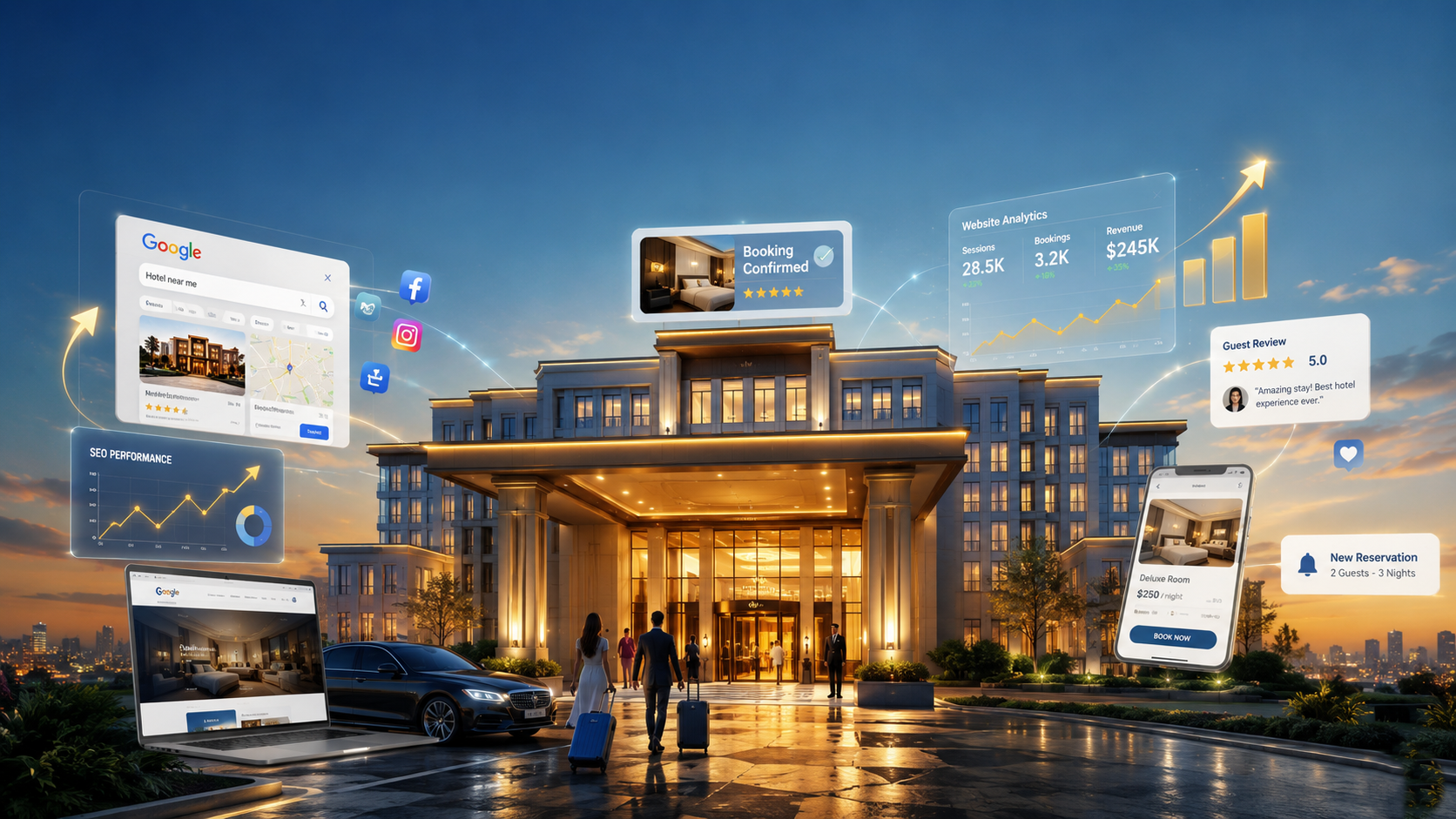
Suppose you own a hotel in Varanasi.
Someone searches:
“best hotel near Varanasi railway station”
Another person searches:
“hotels in Varanasi for family”
Another searches:
“best budget hotel in Varanasi”
If your website has useful, relevant, technically sound and trustworthy pages that match those searches, SEO can help your business become more visible for those queries.
SEO can include:
- Keyword research
- Search intent analysis
- Technical SEO
- On-page SEO
- Content strategy
- Internal linking
- Local SEO
- Website optimization
- Page experience improvements
- Structured data where appropriate
- Digital PR and legitimate authority-building activities
- Google Business Profile optimization
- Conversion optimization
- Search performance analysis
The important point is that SEO is not simply adding keywords to a website.
Modern SEO is much broader.
A website can contain the keyword “best digital marketing agency in Varanasi” 50 times and still fail to provide a useful experience.
The objective should be to create a page that genuinely helps the person searching.
What Are Google Ads?
Google Ads is Google’s advertising platform.
Businesses can use Google Ads to promote products and services across Google’s advertising ecosystem.
For search advertising, businesses can create campaigns intended to show ads when people search for relevant terms.
For example, if you operate a digital marketing agency and someone searches:
“digital marketing agency in Varanasi”
you may create a Google Ads campaign targeting relevant search intent.
Google explains that keywords can connect advertisers with people searching for products or services, with ads potentially appearing for relevant searches.
However, Google Ads is not simply:
“Choose keyword → pay money → get customer.”
There are many variables involved.
These can include:
- Search query
- Keyword targeting
- Match type
- Ad relevance
- Landing page experience
- Geographic targeting
- Device
- Audience signals
- Budget
- Bidding strategy
- Conversion tracking
- Competition
- Search intent
- Ad quality
- Account structure
Google’s current advertising systems also use AI-powered bidding and contextual signals to optimize bids at auction time.
So effective Google Ads management requires much more than simply increasing the daily budget.
SEO vs Google Ads: The Basic Difference
The simplest way to understand the difference is this:
SEO attempts to earn organic visibility.
Google Ads purchases advertising opportunities.
Imagine Google as a busy marketplace.
SEO is like building an excellent shop, becoming known in the market, creating useful resources and gradually earning a strong location based on relevance and reputation.
Google Ads is like paying for a prominent advertising placement when potential customers are actively searching.
Both can be useful.
But they solve different problems.
SEO vs Google Ads: Quick Comparison
| Factor | SEO | Google Ads |
| Traffic type | Organic | Paid |
| Initial speed | Usually slower | Usually faster |
| Long-term potential | Strong | Depends on continued ad spend |
| Immediate visibility | Limited | Potentially high |
| Cost model | Investment in optimization/content | Advertising spend + management |
| Best for | Long-term visibility | Immediate demand capture |
| Brand authority | Can build over time | Primarily advertising visibility |
| Keyword control | Less direct | More direct targeting controls |
| Testing speed | Slower | Faster |
| Data availability | Search performance data | Detailed campaign data |
| Traffic stops when | Rankings/traffic decline | Budget/campaign stops |
| Local businesses | Very useful | Very useful |
| E-commerce | Very useful | Very useful |
| Lead generation | Very useful | Very useful |
| Long-term strategy | Excellent fit | Usually complementary |
The table should not be interpreted as saying one channel is universally superior.
Your business model determines the appropriate balance.
How SEO Works
A successful SEO strategy usually starts with understanding search intent.
Imagine someone searches:
“what is SEO?”
That person may simply be learning.
Someone searching:
“SEO agency pricing”
is further along.
Someone searching:
“SEO agency in Varanasi”
may have strong commercial intent.
And someone searching:
“hire SEO agency Varanasi”
may be even closer to making a decision.
These searches have different intent.
Therefore, an effective SEO strategy should not target keywords only based on search volume.
It should consider:
1. Relevance
Does the keyword actually relate to your business?
2. Search intent
What does the person actually want?
3. Commercial value
Can this search eventually generate revenue?
4. Competition
How difficult is it to compete?
5. Business economics
Is a customer acquired through this search valuable enough to justify the investment?
This is why SEO should be connected to business strategy rather than treated as a separate technical activity.
How Google Ads Works
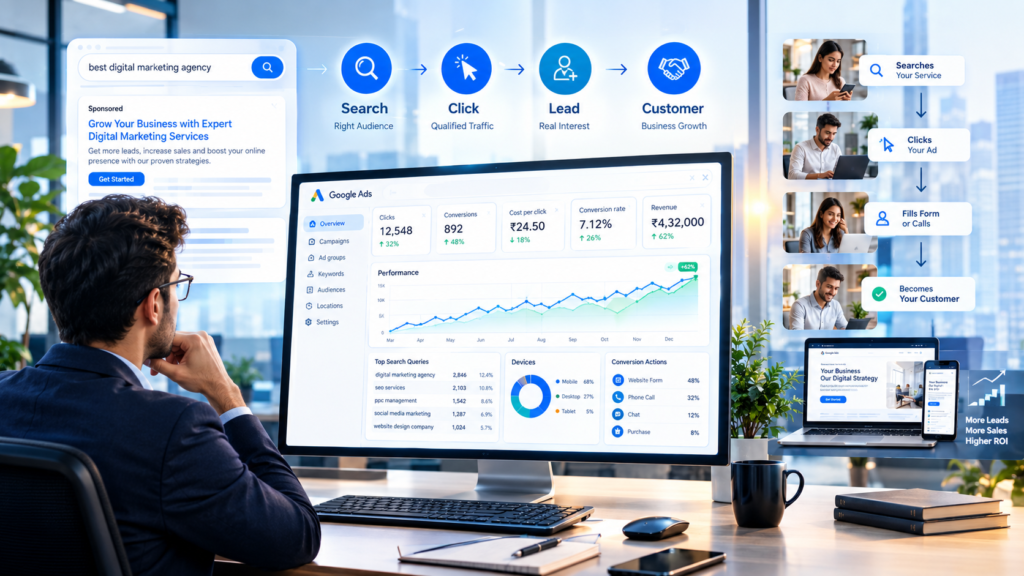
Google Ads operates through advertising auctions.
When someone searches, Google’s systems determine which eligible ads may participate and how those ads should be served.
Modern Google Ads also includes increasingly sophisticated automation.
For example, Smart Bidding uses Google AI to optimize bids for conversions or conversion value at auction time. Google’s documented strategies include options such as Maximize Conversions, Target CPA, Maximize Conversion Value and Target ROAS, although naming and interface terminology can evolve.
Google also provides different keyword matching options.
These include:
- Broad match
- Phrase match
- Exact match
Google explains that broad match can reach a wider variety of relevant searches, while exact match provides greater steering over search intent but generally reaches fewer searches.
This means Google Ads in 2026 is increasingly about:
data + conversion tracking + automation + creative + landing pages + strategy
rather than merely selecting a list of keywords.
Advantages of SEO
1. Long-Term Organic Visibility
One of the biggest attractions of SEO is the possibility of generating organic traffic without paying for every individual click.
Once you build strong organic visibility, the resulting traffic can continue arriving over time.
That doesn’t mean SEO is “free.”
It isn’t.
You may invest in:
- SEO professionals
- Content writers
- Developers
- Tools
- Research
- Design
- Link acquisition
- Local SEO
- Technical optimization
But unlike a simple pay-per-click model, the asset you’re building is your website and its search visibility.
2. SEO Can Build Brand Authority
Suppose a potential customer repeatedly sees your company appearing when searching for useful information.
They may start recognizing your brand.
For example, someone might first discover your website through:
“how much does Google Ads cost?”
Then later through:
“Google Ads conversion tracking”
Then:
“best Google Ads agency in Varanasi”
Your content has gradually introduced the customer to your brand.
This is one reason content-led SEO can be valuable for businesses with longer customer journeys.
3. SEO Can Capture Different Stages of the Customer Journey
A strong SEO strategy shouldn’t focus only on buyers.
You can create content for:
Awareness
“What is digital marketing?”
Consideration
“SEO vs Google Ads”
Evaluation
“How much does SEO cost?”
Purchase
“SEO agency in Varanasi”
Retention
“How to measure digital marketing ROI?”
This creates a broader organic ecosystem.
Disadvantages of SEO
SEO isn’t magic.
It has challenges.
1. Results Usually Take Time
SEO often requires patience.
You may publish a great article today and not immediately receive substantial traffic tomorrow.
Search visibility can require consistent work.
2. Competition Can Be Strong
Some keywords have extremely competitive search results.
Trying to rank a new website immediately for a highly competitive national keyword can be unrealistic.
3. Algorithm Changes
Search systems evolve.
Businesses need to monitor performance and adapt.
4. Poor SEO Can Waste Money
Publishing hundreds of low-value articles isn’t automatically an SEO strategy.
The goal should be quality, relevance, usefulness and business alignment.
Advantages of Google Ads
1. Faster Market Entry
One major advantage of Google Ads is speed.
Instead of waiting for organic visibility to develop, a properly configured advertising campaign can potentially begin generating impressions and clicks much sooner.
This can be particularly useful when launching:
- A new service
- A new product
- A limited-time offer
- A seasonal campaign
- A new location
- An urgent lead-generation campaign
2. Strong Commercial Intent
Search advertising can be particularly valuable when people are already looking for a solution.
Consider the difference between:
“what is digital marketing?”
and:
“digital marketing agency near me”
The second query may indicate significantly stronger commercial intent.
A good Google Ads strategy attempts to capture valuable demand rather than simply generating traffic.
3. Faster Testing
Google Ads can be used as a testing laboratory.
You can test:
- Headlines
- Offers
- Landing pages
- Services
- Locations
- Search terms
- Calls to action
- Pricing angles
- Conversion flows
The resulting data can also inform broader marketing decisions.
Disadvantages of Google Ads
1. You Pay for Traffic
This is obvious but important.
When the advertising budget stops, paid traffic can stop too.
Therefore, businesses need to evaluate Google Ads based on profitability, not simply clicks.
2. Poor Campaigns Can Burn Money
Google Ads isn’t a vending machine where you insert ₹1,000 and automatically receive ₹10,000.
A poorly configured campaign can attract:
- Irrelevant searches
- Low-intent users
- Unqualified leads
- Expensive clicks
- Low-converting traffic
This is why conversion tracking and optimization matter.
3. Competition Affects Costs
Popular commercial keywords can be competitive.
If several businesses want the same audience, advertising economics can become more challenging.
Therefore, simply increasing bids isn’t always the correct strategy.
Sometimes the better solution is:
better targeting + better ad messaging + better landing page + better conversion tracking.
SEO vs Google Ads for Different Types of Businesses
The answer changes depending on your business.
Let’s examine several scenarios.
SEO vs Google Ads for Local Businesses
Suppose you own:
- Restaurant
- Hotel
- Salon
- Clinic
- Coaching institute
- Real estate company
- Digital marketing agency
- Travel company
- Wedding service
- Home service business
Local search can be extremely important.
Potential customers may search:
“best restaurant in Varanasi”
“hotel near Varanasi Cantt”
“digital marketing agency in Varanasi”
“SEO agency near me”
“Google Ads agency Varanasi”
For local businesses, SEO should not be limited to the website.
A local search strategy can involve:
- Google Business Profile
- Location pages
- Reviews
- Local content
- NAP consistency
- Relevant local citations
- On-page optimization
- Local keyword research
- Service-area targeting
- Conversion optimization
Google Ads can complement this by targeting high-intent searches where paid visibility makes commercial sense.
For a local business, therefore, the SEO vs Google Ads question often becomes:
How much organic visibility can we build while using paid search to capture immediate demand?
SEO vs Google Ads for Lead Generation
Lead-generation businesses need to think beyond traffic.
Imagine two websites.
Website A
10,000 visitors
100 leads
10 customers
Website B
2,000 visitors
200 leads
30 customers
Which website is actually more valuable?
The answer depends on revenue and profitability, but the example demonstrates a crucial principle:
Traffic is not the same as business growth.
For lead generation, monitor:
- Cost per lead
- Lead quality
- Qualified lead rate
- Sales conversion rate
- Customer acquisition cost
- Revenue per customer
- Customer lifetime value
- Return on advertising spend where applicable
This applies to both SEO and Google Ads.
SEO vs Google Ads for E-commerce
E-commerce businesses often have multiple acquisition channels.
Google Ads can help capture transactional demand.
SEO can help build organic visibility across:
- Product pages
- Category pages
- Buying guides
- Comparison content
- Problem-solving content
- Informational queries
- Brand searches
For example, a furniture company could target transactional searches through advertising while building organic content around:
- How to choose a sofa
- Best sofa size for small rooms
- Sofa maintenance guide
- Modular vs traditional furniture
- How to design a small living room
The combination can cover multiple stages of the customer journey.
SEO vs Google Ads for Startups
Startups often have limited resources.
That means prioritization matters.
A startup should first identify:
- Who is the customer?
- What problem does the product solve?
- What keywords indicate buying intent?
- What is the average customer value?
- How quickly must revenue be generated?
- What acquisition cost is sustainable?
If the startup needs immediate demand testing, Google Ads can be useful.
If the startup is building a long-term content-driven acquisition engine, SEO may deserve substantial attention.
A combination can also work.
For example:
Google Ads → test commercial keywords → analyze conversions → invest in SEO around proven themes.
This can reduce some of the guesswork involved in deciding which topics deserve long-term organic investment.
SEO vs Google Ads for Established Businesses
Established businesses often have an advantage because they already have:
- Brand recognition
- Website history
- Existing customers
- Data
- Content
- Reviews
- Search demand
- Conversion data
Such businesses may benefit from using SEO and paid search simultaneously.
SEO can protect and expand organic visibility.
Google Ads can capture incremental demand, support launches and target specific commercial searches.
The challenge becomes channel coordination.
Instead of operating SEO and Google Ads as two unrelated departments, businesses can use data from both.
SEO vs Google Ads: Which Is More Cost Effective?
This is one of the most common questions.
And it has no universal answer.
Let’s use a simple example.
Suppose your Google Ads campaign spends:
₹50,000
and generates:
100 leads
Your average cost per lead is:
₹500
But suppose only 20 of those leads become customers.
Then your acquisition cost is:
₹2,500 per customer
Now imagine each customer generates ₹10,000 in gross profit.
That could be economically attractive.
But if each customer generates only ₹1,000 in gross profit, the same campaign may not make financial sense.
The important lesson:
Never evaluate Google Ads only on CPC.
Similarly, don’t evaluate SEO only on ranking position.
Evaluate the business outcome.
What About SEO Cost?
SEO may involve a monthly investment.
For example:
- Strategy
- Technical SEO
- Content
- Design
- Development
- Local SEO
- Analytics
- Optimization
The benefit is that you’re building a digital asset.
However, SEO isn’t guaranteed.
There is no ethical SEO professional who can honestly guarantee a specific Google ranking for every keyword.
The right goal is to improve:
visibility → qualified traffic → conversions → revenue
Can SEO Really Be Free?
Technically, you can learn SEO and implement some activities yourself.
But your time has value.
If a business owner spends 20 hours every month researching keywords, writing articles, fixing technical issues and analyzing search performance, those hours aren’t free.
There is an opportunity cost.
This is why businesses should consider:
What is the most efficient use of my team’s time?
If you’re a restaurant owner, you probably don’t want to spend your evenings diagnosing canonical tags.
You probably want to:
- Improve operations
- Serve customers
- Develop products
- Manage employees
- Increase revenue
Specialized SEO support can make sense when the opportunity cost of doing everything internally becomes high.
Can Google Ads Really Be Expensive?
Yes.
But “expensive” isn’t simply about the click price.
Suppose:
Campaign A:
₹200 CPC
10% conversion rate
Campaign B:
₹80 CPC
1% conversion rate
At first glance, Campaign B appears cheaper.
But let’s calculate.
Campaign A:
₹200 / 10% = ₹2,000 estimated cost per conversion
Campaign B:
₹80 / 1% = ₹8,000 estimated cost per conversion
The cheaper click produced the more expensive conversion.
This is why serious Google Ads management focuses on conversion economics, not vanity metrics.
Why Conversion Tracking Matters
If you don’t know which clicks generate customers, you’re essentially driving with your eyes closed.
Conversion tracking helps businesses understand what actions matter.
Depending on your business, conversions could include:
- Phone calls
- WhatsApp enquiries
- Contact forms
- Purchases
- Booking requests
- Demo requests
- Quote requests
- Sign-ups
- Store visits
- Qualified leads
The definition of “conversion” should reflect the actual business objective.
For an e-commerce store, a purchase may be the most important conversion.
For a B2B agency, a qualified lead may matter more than a simple form submission.
This distinction is extremely important.
Google Ads in 2026: What Has Changed?
The Google Ads ecosystem continues moving toward greater automation and AI-assisted campaign management.
Google’s current documentation describes Smart Bidding as AI-powered auction-time optimization that uses signals to adjust bids according to the likelihood of conversions or conversion value.
Google also continues to emphasize broad match alongside Smart Bidding for suitable campaigns.
Google has also documented changes around campaign-level broad match and AI Max beginning in September 2026.
For advertisers, the strategic implication is important:
The future of Google Ads is becoming less about manually controlling every individual bid and more about providing high-quality inputs, accurate conversion data, strong creative assets, appropriate targeting and clear business goals.
That doesn’t mean human strategy is becoming irrelevant.
Quite the opposite.
As automation increases, strategic thinking becomes more important.
Someone still needs to decide:
- What should we advertise?
- Who is our ideal customer?
- Which locations matter?
- What counts as a valuable conversion?
- What offer should we present?
- Which customers are profitable?
- Which searches should we avoid?
- What landing page should receive traffic?
Automation can optimize a campaign.
It cannot replace a sound business model.
Broad Match and Smart Bidding
Google states that broad match can capture a wider range of relevant searches and recommends pairing broad match with Smart Bidding in appropriate circumstances.
This matters because old-school Google Ads thinking often looked like:
“I need to manually build thousands of keywords.”
Modern systems can work differently.
The focus increasingly shifts toward:
intent + data + conversion quality + automation
However, that doesn’t mean advertisers should blindly enable every automated setting.
The campaign still needs:
- Proper conversion tracking
- Search-term monitoring
- Negative keyword management
- Relevant landing pages
- Clear campaign objectives
- Budget discipline
- Testing
Automation without strategy can simply automate bad decisions faster.
The Role of Content in SEO
Content remains an important component of SEO, but quantity shouldn’t be the primary objective.
Imagine two websites.
Website A
Publishes 500 generic AI-written articles.
Website B
Publishes 50 genuinely useful resources answering real customer questions.
The second website may create a stronger user experience.
Your content should answer:
“Why should someone read this instead of the other ten results?”
That is the standard businesses should aim for.
Useful content can include:
- Detailed guides
- Tutorials
- Case studies
- Comparisons
- Original research
- Industry insights
- FAQs
- Calculators
- Checklists
- Expert explanations
- Local guides
- Product comparisons
The objective is not to produce content simply because a keyword exists.
The objective is to satisfy a real information need.
Why Local SEO Matters in Varanasi
For businesses serving Varanasi, local search can be particularly relevant.
A customer may not search for a generic national term.
They may search:
“digital marketing agency in Varanasi”
“SEO company in Varanasi”
“Google Ads agency in Varanasi”
“digital marketing company near me”
“best marketing agency for hotel in Varanasi”
These searches contain location and/or commercial intent.
For a local business, an effective strategy can combine:
Website SEO
Build relevant service pages.
Local SEO
Strengthen local search visibility.
Google Business Profile
Keep business information accurate and useful.
Reviews
Encourage genuine customer feedback.
Local content
Create useful resources related to the market you serve.
Google Ads
Capture high-intent searches where paid acquisition economics make sense.
For businesses in Varanasi, this can create a much more focused strategy than simply trying to rank nationally for broad keywords.
SEO vs Google Ads: A Practical Example for a Varanasi Business
Let’s say a hotel in Varanasi wants more bookings.
Its target customers could include:
- Domestic tourists
- International tourists
- Families
- Business travelers
- Pilgrims
- Wedding guests
- Long-stay visitors
The hotel could create SEO content around:
- Hotels in Varanasi
- Hotels near major attractions
- Family accommodation
- Business accommodation
- Varanasi travel guides
- Local attraction guides
- Area-specific hotel pages
At the same time, Google Ads could be used for high-intent searches such as:
“book hotel in Varanasi”
“hotel near Varanasi railway station”
“hotel near Kashi Vishwanath”
The SEO strategy builds a long-term organic acquisition engine.
The advertising strategy captures immediate demand.
That is the power of combining both.
The Biggest Mistake: Treating SEO and Google Ads as Competitors
Many businesses make this mistake.
They think:
“I need to choose one.”
But SEO and Google Ads can work together.
Think of them as two different engines.
SEO Engine
Designed for:
- Long-term visibility
- Organic traffic
- Content discovery
- Brand authority
- Search demand capture
- Sustainable acquisition
Google Ads Engine
Designed for:
- Immediate visibility
- Commercial intent
- Demand capture
- Rapid testing
- Targeted campaigns
- Scalable paid acquisition
The strongest strategy is often not:
SEO OR Google Ads
but:
SEO + Google Ads + Conversion Optimization
A Strategic SEO + Google Ads Framework
Here’s a practical framework businesses can use.
Stage 1: Research
Identify:
- Products
- Services
- Customers
- Locations
- Search intent
- Competitors
- Commercial keywords
- Informational keywords
Stage 2: Build the Website Foundation
Make sure your website clearly communicates:
- What you do
- Who you serve
- Where you operate
- Why customers should trust you
- How customers can contact you
A beautiful website that doesn’t convert visitors is just an expensive digital brochure.
Stage 3: Build SEO Content
Create content around:
Informational intent
“What is SEO?”
Commercial investigation
“SEO vs Google Ads”
Transactional intent
“SEO agency in Varanasi”
Problem-based searches
“Why is my website not getting Google traffic?”
This creates a complete search ecosystem.
Stage 4: Launch Google Ads Around High-Intent Searches
Start with commercially relevant searches.
For example:
- Service + location
- Service + price
- Service + agency
- Service + company
- Hire + service
- Buy + product
- Book + service
Don’t blindly target every keyword.
The question should always be:
“If this person clicks, is there a realistic path to revenue?”
Stage 5: Measure Everything
Create a dashboard containing:
- Impressions
- Clicks
- CTR
- CPC
- Leads
- Qualified leads
- Conversion rate
- Cost per lead
- Customers
- Customer acquisition cost
- Revenue
- ROAS where applicable
- Organic traffic
- Organic conversions
- Organic revenue
This transforms marketing from guessing into measurement.
A 90-Day SEO + Google Ads Plan
Days 1–30: Foundation
SEO
- Technical audit
- Keyword research
- Search intent mapping
- Competitor analysis
- Google Business Profile review
- Website conversion audit
- Core service pages
- Initial content strategy

Google Ads
- Conversion tracking
- Campaign structure
- Location targeting
- High-intent keyword research
- Ad copy testing
- Landing page setup
- Negative keyword strategy
Days 31–60: Optimization
SEO
Publish:
- Commercial pages
- Supporting informational content
- Local pages
- FAQs
- Comparison articles
- Service guides
Improve:
- Internal links
- Metadata
- Page structure
- Conversion paths
Google Ads
Analyze:
- Search terms
- Lead quality
- Conversion rates
- Cost per conversion
- Ad performance
- Landing page performance
Move budget toward campaigns and searches producing meaningful business outcomes.
Days 61–90: Scaling
At this stage, look for patterns.
Which keywords generate:
- Traffic?
- Leads?
- Qualified leads?
- Customers?
- Revenue?
Use this data to inform both channels.
If Google Ads reveals that a particular service keyword produces high-quality customers, consider creating stronger SEO content around the same intent.
If SEO reveals that a particular topic attracts valuable customers, consider whether paid search can accelerate visibility for that commercial opportunity.
This is where SEO and Google Ads stop being separate activities.
They become one search marketing system.
Common SEO Mistakes Businesses Make
Mistake 1: Keyword Stuffing
Repeating a keyword excessively doesn’t automatically improve rankings.
A page should be written for humans first.
Mistake 2: Publishing Without Search Intent
You can rank for a keyword and still fail to generate customers if your page doesn’t satisfy what the user wants.
Mistake 3: Chasing Only High-Volume Keywords
A keyword with 50,000 searches isn’t necessarily more valuable than one with 500 searches.
If the smaller keyword has strong commercial intent, it may generate more business.
Mistake 4: Ignoring Conversion Optimization
Getting visitors to your website is only half the job.
What happens next?
Common Google Ads Mistakes
Mistake 1: Optimizing for Clicks Instead of Customers
A campaign can generate thousands of clicks and still lose money.
Mistake 2: No Conversion Tracking
Without conversion data, optimization becomes difficult.
Mistake 3: Poor Landing Pages
Imagine clicking an advertisement for:
“Digital Marketing Agency in Varanasi”
and landing on a homepage that doesn’t mention Varanasi, doesn’t explain services and has no clear enquiry button.
The ad may have worked.
The landing page didn’t.
Mistake 4: Ignoring Search Terms
Advertisers should understand what searches actually trigger their campaigns.
Google provides tools and reporting for understanding search terms and managing negative keywords.
Mistake 5: Increasing Budget Before Fixing Conversion Problems
If a campaign has poor conversion economics, increasing the budget can simply increase the amount of money being wasted.
First fix:
targeting → message → landing page → conversion tracking → sales process
Then consider scaling.
SEO or Google Ads: How Should You Decide?
Ask yourself these questions.
Question 1: Do I need customers quickly?
If yes, paid search may deserve immediate attention.
Question 2: Am I building a long-term brand?
If yes, SEO can become an important acquisition asset.
Question 3: Do people already search for my service?
If yes, search marketing may be particularly relevant.
Question 4: Is my website ready to convert traffic?
If no, fix that before aggressively scaling traffic.
Question 5: What’s my customer lifetime value?
The answer determines how much acquisition investment may be sustainable.
Question 6: How competitive is my market?
Competition affects both organic and paid strategies.
Question 7: Do I have enough time?
SEO requires consistency.
Question 8: Do I have enough budget?
Google Ads requires ongoing advertising investment.
When SEO May Make More Sense
SEO can be particularly useful when:
- You want long-term organic visibility.
- Your industry has substantial search demand.
- Your customers research before buying.
- You can invest consistently.
- You want to build a content asset.
- You have multiple relevant topics to cover.
- Your business has strong customer lifetime value.
When Google Ads May Make More Sense
Google Ads can be particularly useful when:
- You need immediate visibility.
- Your product has strong search demand.
- You have a profitable customer acquisition model.
- You want to test offers quickly.
- You are launching a new service.
- You operate in a location-specific market.
- You want to capture high-intent searches.
When Using Both Makes Sense
A combined approach can be useful when:
- You have enough budget for paid acquisition.
- You want immediate and long-term growth.
- Your customers use Google throughout the buying journey.
- You want to test keywords rapidly.
- You want to build organic visibility around proven commercial themes.
For many businesses, this is the most strategically interesting model.
The 2026 Search Marketing Mindset
The biggest change businesses need to understand is this:
Don’t optimize for traffic. Optimize for profitable customer acquisition.
Traffic is a metric.
Leads are a metric.
Clicks are a metric.
Rankings are a metric.
Revenue is a business outcome.
Your marketing strategy should connect the first four to the last one.
For example:
Keyword → Click → Landing Page → Lead → Qualified Lead → Sale → Revenue
If you don’t understand the entire chain, you don’t fully understand your marketing performance.
SEO vs Google Ads: Think Beyond Rankings
A business owner may say:
“We are ranking at number 3.”
Great.
But how many customers does that ranking generate?
Another may say:
“Our Google Ads CTR is 8%.”
Interesting.
But how many profitable customers came from those clicks?
This is why strategic digital marketing goes beyond dashboard numbers.
The real objective is:
Acquire the right customer at a sustainable cost and convert that customer profitably.
How Digital Janxii Approaches Search Marketing
At Digital Janxii, based in Varanasi, our approach is built around a simple principle:
Marketing should generate business, not merely reports.
SEO and Google Ads should not exist in isolation.
A business may need:
- SEO
- Google Ads
- Local SEO
- Website optimization
- Conversion optimization
- Digital marketing
- E-commerce growth
- OTA growth
- Sales strategy
- Customer acquisition strategy
The right combination depends on the business.
For example, an e-commerce company may need a different strategy from a hotel.
A hotel may need a different strategy from a local service business.
A B2B company may require a different customer journey from a restaurant.
Therefore, before recommending a channel, businesses should understand:
Customer + Market + Search Demand + Competition + Economics + Conversion Process
That is where strategy begins.
Why Businesses Shouldn’t Choose an Agency Based Only on Price
Suppose Agency A charges ₹10,000 per month.
Agency B charges ₹25,000.
Agency C charges ₹50,000.
Which one should you hire?
The monthly fee alone doesn’t answer the question.
Instead, ask:
- What exactly will be done?
- What business objectives are being targeted?
- How will performance be measured?
- What reporting will be provided?
- What conversion tracking will be implemented?
- How will keyword strategy be developed?
- How will campaigns be optimized?
- What happens when performance changes?
- How transparent is the agency?
- Does the agency understand your business model?
The cheapest marketing service can become expensive if it generates no business.
The expensive service can also become wasteful if the strategy is poor.
The correct focus should be:
value generated relative to investment.
How to Build a Lead-Generation Website
If your goal is to generate leads through SEO or Google Ads, your website needs more than good design.
It should clearly answer:
What do you offer?
State the service clearly.
Who is it for?
Make your target audience obvious.
Where do you operate?
Especially important for local businesses.
Why should someone trust you?
Use:
- Case studies
- Testimonials
- Reviews
- Experience
- Results
- Certifications where relevant
- Transparent information
What should the visitor do next?
Give them a clear action:
- Call
- Book
- Request a quote
- Submit an enquiry
- Schedule a consultation
Don’t make visitors play “Where is the contact button?”
SEO vs Google Ads: The Strategic Answer
So, SEO or Google Ads?
The answer depends on your situation.
If you need immediate demand capture, Google Ads can be valuable.
If you want to build long-term organic visibility, SEO can be valuable.
If you’re trying to create a stronger overall search acquisition system, combining both can be powerful.
Think of it this way:
Google Ads can help you buy attention.
SEO can help you earn attention.
Conversion optimization helps you turn attention into action.
Sales processes turn action into customers.
Customer experience turns customers into repeat business and referrals.
That is the complete system.
Frequently Asked Questions About SEO vs Google Ads
Is SEO better than Google Ads?
Neither is universally better.
SEO and Google Ads serve different purposes.
SEO focuses on organic search visibility, while Google Ads provides paid advertising opportunities.
The appropriate strategy depends on your objectives, timeline, competition, budget and customer acquisition economics.
Is Google Ads better than SEO?
Not universally.
Google Ads can provide faster visibility, while SEO can build long-term organic search visibility.
Many businesses use both.
Which is cheaper: SEO or Google Ads?
There is no universal answer.
Google Ads involves direct advertising spend.
SEO involves investment in strategy, content, technical work and optimization.
The more useful question is:
Which channel produces customers at a sustainable acquisition cost for my business?
How long does SEO take to work?
It varies.
Factors include:
- Website authority
- Competition
- Industry
- Technical health
- Content quality
- Search demand
- Location
- Existing visibility
- SEO execution
Avoid anyone promising guaranteed rankings within an arbitrary number of days.
How quickly can Google Ads generate leads?
Google Ads can begin generating traffic relatively quickly once campaigns are active and eligible, but the quality and quantity of leads depend on factors such as demand, targeting, budget, ads, landing pages and conversion tracking.
Fast traffic does not automatically mean profitable traffic.
Can I run SEO and Google Ads together?
Yes.
In many cases, the channels can complement each other.
You can use paid search for immediate demand capture while building organic visibility for the long term.
Should a small business invest in SEO?
It depends on whether potential customers use search to discover or research the business.
For local businesses, service businesses and companies with ongoing search demand, SEO can be particularly useful.
Should a new business start with Google Ads?
It can be useful when immediate customer acquisition or market testing is important.
However, the business should first ensure that its offer, website, conversion tracking and sales process are ready.
Otherwise, advertising may simply send more people into a broken funnel.
Is SEO still relevant in 2026?
Yes, search visibility remains relevant, but businesses should think beyond traditional “rank for keyword” SEO.
Modern search strategy should focus on:
- Helpful content
- Search intent
- Technical quality
- User experience
- Brand
- Local visibility where relevant
- Business relevance
- Conversions
Google continues to provide SEO guidance through Search Central, including resources around Search Essentials, search appearance and site performance.
Is Google Ads worth it in 2026?
It can be, if the economics work.
The key questions are:
How much does a customer cost?
How much profit does that customer generate?
Can the campaign scale while remaining economically sustainable?
Those questions are more important than simply asking whether Google Ads is “worth it.”
Final Conclusion: SEO vs Google Ads in 2026
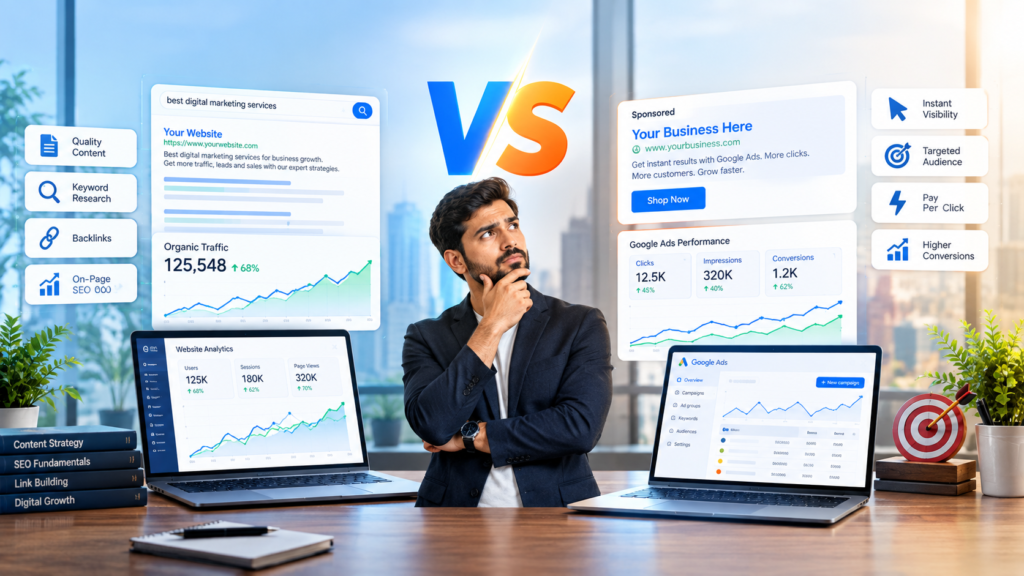
The SEO vs Google Ads debate is often presented as a competition.
But smart businesses should look at it differently.
SEO and Google Ads are two different components of a broader search marketing strategy.
SEO can help you build long-term organic visibility.
Google Ads can help you capture demand through paid search.
Conversion optimization can turn visitors into leads.
Sales systems can turn leads into customers.
And business analytics can tell you whether the entire system is profitable.
Instead of asking:
“SEO or Google Ads?”
Ask:
“What combination of search marketing channels can acquire my ideal customers profitably and sustainably?”
That question leads to a much better strategy.
For some businesses, the answer may be SEO.
For others, Google Ads.
For many businesses, the answer may be a carefully managed combination of both.
The goal isn’t to win the SEO vs Google Ads argument.
The goal is to win the customer.
Want to Grow Your Business Through Google Search?
If you’re a business owner in Varanasi or elsewhere in India and you’re trying to generate more qualified leads, improve online visibility, increase e-commerce sales or build a stronger digital acquisition system, Digital Janxii can help you evaluate the right strategy.
We work across areas such as:
- SEO
- Google Ads
- Digital Marketing
- Local SEO
- Lead Generation
- E-commerce Growth
- OTA Growth
- Online Sales Growth
- Conversion Optimization
- Business Growth Strategy
Instead of blindly recommending SEO or Google Ads, the right approach starts by understanding your:
Business → Customer → Market → Competition → Search Demand → Conversion Funnel → Revenue
Because the objective isn’t simply to get more clicks.
It is to get more relevant customers and better business results.
Digital Janxii — Turning Digital Marketing Into Business Growth.