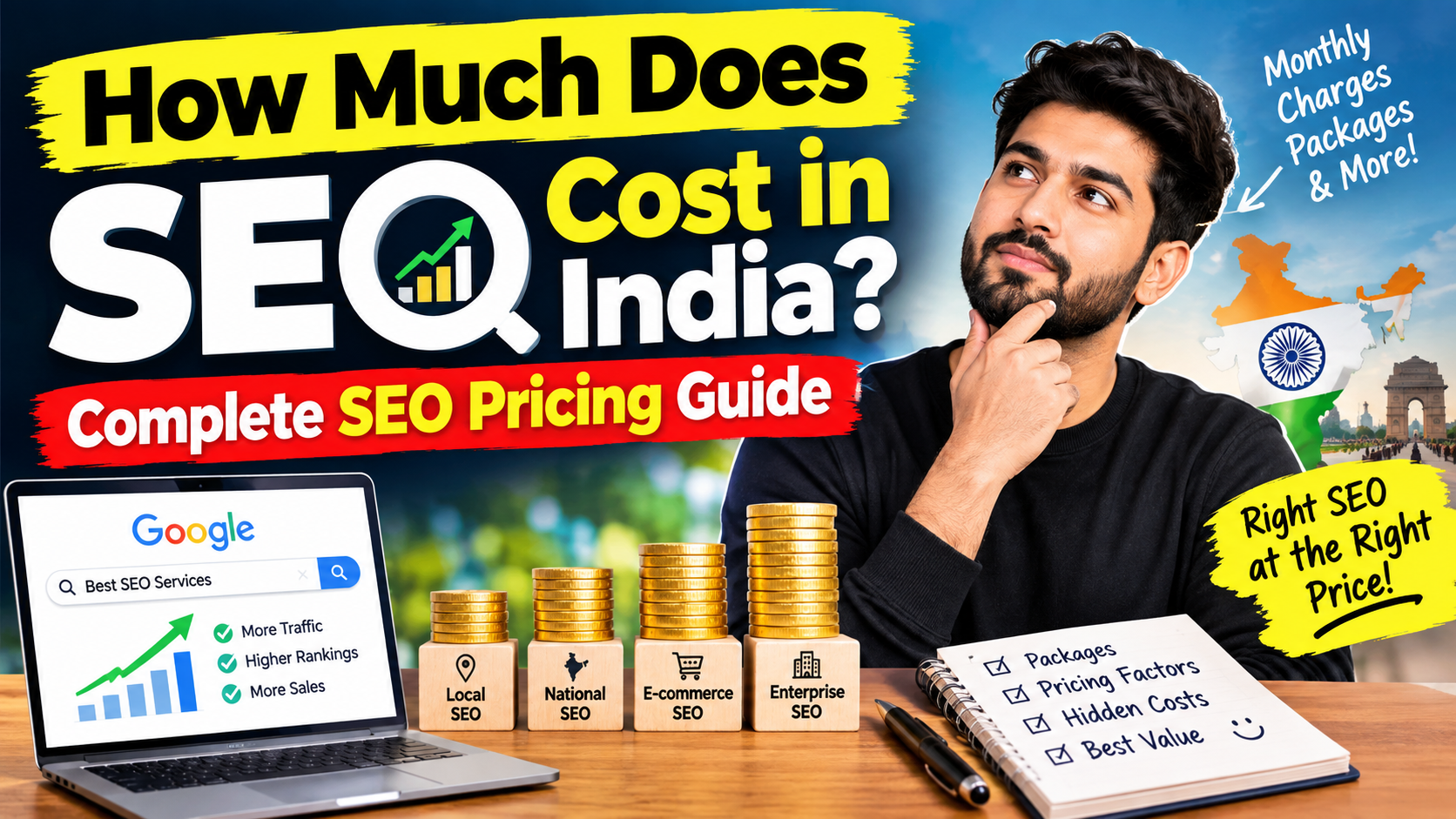
How much does SEO cost in India in 2026? Explore SEO pricing, monthly charges, packages, local SEO, e-commerce SEO, agency costs, audits and GEO tips.
So, how much does SEO actually cost in India in 2026?
However, the monthly price alone does not tell you whether an SEO package is good, expensive or cheap.
The more important question is:
What exactly are you getting for that SEO investment?
A ₹20,000 SEO package that includes a genuine technical strategy, quality content, on-page optimization, local SEO and meaningful authority building can potentially be far more useful than a ₹50,000 package where most of the work consists of automated reports and generic backlinks.
This complete guide explains SEO pricing in India in 2026, different SEO packages, monthly SEO charges, freelancer versus agency pricing, local SEO costs, e-commerce SEO costs, enterprise SEO pricing, one-time SEO audits, factors that influence SEO costs, what an SEO agency should actually deliver, how long SEO takes, how to calculate an SEO budget and how to choose an SEO company without wasting your money.
Quick Answer: How Much Does SEO Cost in India in 2026?
Here is a practical overview of commonly quoted SEO pricing ranges in India.
| SEO Service | Approximate Cost in India | Suitable For |
| Basic Local SEO | ₹10,000–₹25,000/month | Small local businesses |
| Small Business SEO | ₹15,000–₹40,000/month | SMEs and service businesses |
| Growth SEO | ₹25,000–₹60,000/month | Growing businesses |
| National SEO | ₹40,000–₹1,00,000+/month | National brands |
| E-commerce SEO | ₹50,000–₹1,50,000+/month | Online stores |
| Enterprise SEO | ₹1,00,000–₹3,00,000+/month | Large companies |
| One-Time SEO Audit | ₹10,000–₹50,000+ | Technical/content diagnosis |
| SEO Consultation | ₹2,000–₹10,000+/hour | Strategy and expert advice |
| SEO Content | ₹1,500–₹12,000+/article | Content campaigns |
These numbers are indicative market ranges rather than fixed industry prices. Current 2026 pricing guides published by Indian SEO providers show wide variations because the scope of SEO work differs substantially from one project to another.
For example, a local restaurant trying to rank for searches within one city does not require the same amount of work as an e-commerce company competing nationally for thousands of product-related searches.
That is why comparing SEO prices without comparing deliverables can be misleading.
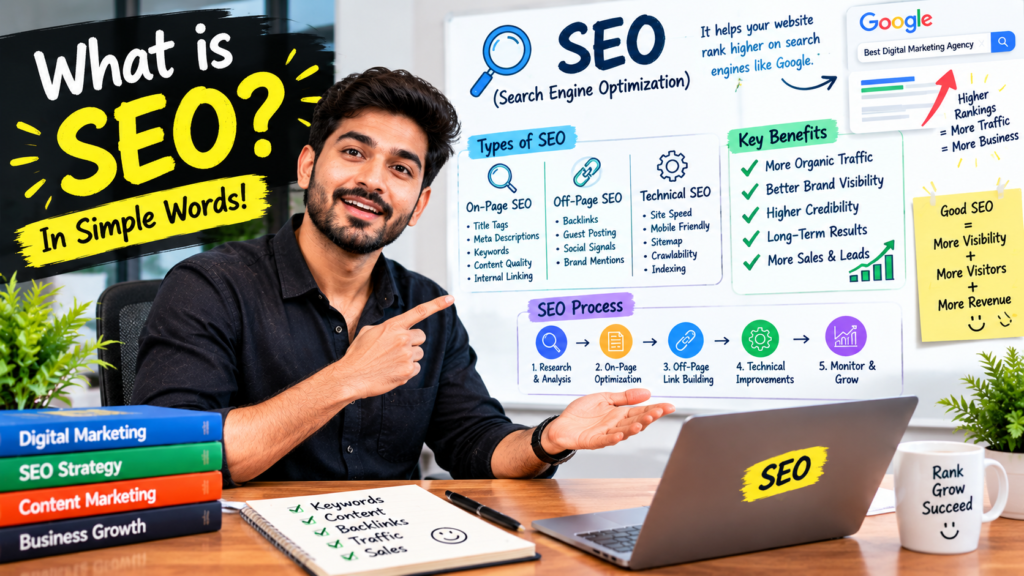
What Is SEO?
SEO stands for Search Engine Optimization.
It is the process of improving a website so that search engines can discover, crawl, understand and potentially rank its pages for relevant searches.
But modern SEO is much broader than simply inserting keywords into an article.
A comprehensive SEO strategy can include:
- Keyword research
- Search intent analysis
- Competitor research
- Technical SEO
- Website architecture
- On-page SEO
- Content strategy
- Content creation
- Internal linking
- Image optimization
- Schema/structured data
- Local SEO
- Google Business Profile optimization
- Digital PR
- Link acquisition
- Conversion optimization
- Analytics
- Search Console monitoring
- E-commerce SEO
- International SEO
- Reputation and brand signals
- Performance analysis

In 2026, SEO also increasingly overlaps with optimization for AI-powered search experiences and generative search.
Google’s own documentation now includes guidance around generative AI features in Search and states that traditional SEO fundamentals continue to matter for visibility in these experiences.
This means that the question is no longer simply:
“How do I rank on Google?”
A more complete question is:
“How do I make my website useful, understandable, trustworthy and discoverable across traditional search and AI-powered search experiences?”
That distinction matters when you evaluate SEO pricing.
Why Does SEO Cost So Differently in India?
The biggest reason is simple:
SEO is not one fixed service.
Imagine two businesses.
Business A
A local salon has:
- One location
- 15 important pages
- 20–30 target search terms
- Low-to-medium competition
- A relatively small website
Its SEO requirements may be manageable.
Now consider Business B.
An e-commerce company has:
- 10,000+ products
- Hundreds of categories
- Multiple product variations
- Thousands of indexed URLs
- Technical SEO problems
- National competition
- Hundreds of commercial keywords
- Regular content requirements
- Competitors with strong domain authority
Clearly, the second company requires substantially more SEO resources.
Therefore, SEO pricing should be based on the scope and difficulty of the work rather than simply the number of keywords promised.
Recent Indian market pricing guides similarly identify competition, content volume, technical requirements, target geography and website complexity as major pricing factors.
SEO Pricing in India: A Detailed Breakdown
Let’s examine the major SEO pricing categories.
1. Basic Local SEO Cost in India
For a small business targeting customers in one city or local area, SEO may start around:
₹10,000–₹25,000 per month
Depending on the provider and scope, a local SEO campaign may include:
- Keyword research
- Google Business Profile optimization
- Local landing pages
- On-page optimization
- Local citations
- Review strategy
- Basic technical SEO
- Internal linking
- Local content
- Monthly reporting
For example, suppose you own a dental clinic in Varanasi.
You may want to appear for searches such as:
- Dentist in Varanasi
- Best dentist in Varanasi
- Dental clinic near me
- Root canal treatment Varanasi
- Teeth whitening Varanasi
You don’t necessarily need an enterprise-level SEO campaign.
The strategy should instead concentrate resources on the geographic market and services that actually generate patients.
2. Small Business SEO Pricing
A typical small-business SEO campaign may fall around:
₹15,000–₹40,000 per month
This can be appropriate for:
- Local service businesses
- Consultants
- Small agencies
- Professional services
- Coaching businesses
- Clinics
- Restaurants
- Hotels
- Real estate professionals
- Educational businesses
- Small manufacturers
- Regional brands
A stronger small-business campaign might include:
Technical SEO
- Crawl analysis
- Indexation checks
- Broken links
- Canonicals
- XML sitemap
- Robots.txt
- Core website issues
- Mobile usability
- Page experience
On-page SEO
- Title tags
- Meta descriptions
- Heading structure
- Content optimization
- Internal links
- Image optimization
Content
- Blog articles
- Service pages
- Location pages
- Comparison content
- Educational resources
Authority
- Relevant link acquisition
- Digital PR opportunities
- Local citations
- Brand mentions
The exact deliverables should always be written into the proposal.
3. Growth SEO Packages
Growing businesses often require a more comprehensive campaign.
A common market range is approximately:
₹25,000–₹60,000 per month
This type of SEO package may be appropriate when a company wants to move beyond a handful of local keywords and build a sustainable organic acquisition channel.
A growth SEO campaign could include:
- Technical SEO
- Comprehensive keyword research
- Content clusters
- Topic authority development
- 4–10 content pieces per month
- Existing-page optimization
- Internal linking
- Digital PR
- Link acquisition
- Conversion optimization recommendations
- Search Console analysis
- Analytics
- Competitor monitoring
The biggest difference is usually depth and scale.
Instead of optimizing five pages, a growth campaign might involve dozens of pages.
Instead of targeting only one or two keywords, it may target entire topic clusters.
4. National SEO Pricing in India
National SEO is considerably more competitive.
Typical budgets can range approximately from:
₹40,000 to ₹1,00,000+ per month
National SEO may be required when you want to compete across India rather than one city.
For example:
A business targeting:
“digital marketing agency”
nationally is competing against a much larger pool of websites than a company targeting:
“digital marketing agency in Varanasi.”
National campaigns often require:
- Larger content production
- Stronger topical authority
- More competitive keyword targeting
- Better technical infrastructure
- More authority-building activities
- Competitor analysis
- Strong internal linking
- Commercial landing pages
- Supporting informational content
- Brand building
The investment can increase significantly when the industry itself is highly competitive.
5. E-commerce SEO Cost in India
E-commerce SEO is one of the more complicated forms of SEO.
A typical e-commerce SEO budget may begin around:
₹50,000 per month
and can move to:
₹1,50,000+ per month
for larger websites.
Enterprise e-commerce projects can cost substantially more.
Why?
Because an online store may have thousands or millions of URLs.
You may have:
- Product pages
- Category pages
- Subcategory pages
- Brand pages
- Filters
- Search pages
- Product variants
- Pagination
- Reviews
- Out-of-stock products
- Duplicate URLs
- Parameter URLs
Technical SEO becomes extremely important.
For example, an online fashion store may accidentally create hundreds of URL variations for:
- Size
- Color
- Brand
- Price
- Sorting
- Filters
If these are not handled correctly, search engines may waste crawling resources or encounter duplicate/near-duplicate pages.
Google’s documentation explains how canonicalization helps search engines identify the representative URL when similar or duplicate pages exist.
That is one reason e-commerce SEO requires more expertise than simply publishing blog posts.
6. Enterprise SEO Cost in India
Large organizations may spend:
₹1,00,000–₹3,00,000+ per month
on SEO.
In some situations, enterprise programs can go substantially higher.
Enterprise SEO often involves:
- Large websites
- Thousands or millions of URLs
- Multiple teams
- Developers
- Content departments
- Multiple locations
- Multiple products
- International markets
- Complex analytics
- Large-scale technical migrations
At this level, the SEO agency may not simply “do SEO.”
Instead, it may work alongside:
- Developers
- Product teams
- Marketing managers
- Content writers
- UX teams
- PR teams
- Data analysts
- E-commerce teams
The cost therefore reflects the complexity of the organization.
7. One-Time SEO Audit Cost in India
If you do not want a monthly SEO package, you can purchase a one-time audit.
A detailed SEO audit may cost approximately:
₹10,000–₹50,000+
depending on the size and complexity of the website.
An enterprise audit can cost significantly more.
A good audit should investigate areas such as:
Technical SEO
- Crawlability
- Indexability
- Canonicals
- Robots.txt
- Sitemaps
- Redirects
- Broken links
- JavaScript rendering
- Mobile experience
- Site architecture
- Page performance
Content
- Thin pages
- Duplicate content
- Search intent mismatch
- Content gaps
- Cannibalization
- Outdated content
- Missing commercial pages
On-page SEO
- Titles
- Headings
- Meta descriptions
- Internal links
- Image optimization
Authority
- Backlink profile
- Referring domains
- Link quality
- Competitor link gaps
Analytics
- Search Console
- Organic traffic
- Conversions
- Landing pages
- Search queries
The key question is:
Does the audit tell you exactly what to fix and why?
A 100-page PDF filled with screenshots isn’t necessarily a better SEO audit.
8. SEO Consultant Charges in India
SEO consultants may charge hourly, per project or on a monthly consulting basis.
Indicative hourly rates can range from:
₹2,000–₹10,000+ per hour
depending on expertise and specialization.
Consulting can make sense when:
- You already have an internal marketing team.
- Developers are available.
- Writers are available.
- You need strategy rather than execution.
- You want an SEO expert to review an existing campaign.
For example, an internal marketing team might hire an SEO consultant for:
- Keyword strategy
- Technical audits
- Content strategy
- Website migration
- International SEO
- E-commerce architecture
- SEO training
The company then handles execution internally.
What Determines SEO Cost in India?
There isn’t one universal SEO price because several variables influence the workload.
Let’s examine the most important ones.
1. Keyword Competition
This is one of the biggest factors.
Ranking for:
“best restaurant in a small city”
may be significantly easier than ranking for:
“best digital marketing agency in India.”
Competition determines how much authority, content depth and optimization may be required.
2. Business Industry
Different industries have different competitive environments.
For example:
- Real estate
- Finance
- Insurance
- Healthcare
- Legal
- SaaS
- E-commerce
can require significant expertise and resources.
A niche B2B company with low search competition may require less investment.
3. Website Size
A website with 20 pages is fundamentally different from a website with 20,000 pages.
Larger websites can require:
- More technical auditing
- More content optimization
- More internal linking
- More crawl analysis
- More monitoring
- More developer involvement
Therefore, website size affects SEO pricing.
4. Website Condition
Two companies may have the same number of pages but completely different technical situations.
Website A:
- Clean architecture
- Fast pages
- Correct indexing
- Strong content
Website B:
- Thousands of broken URLs
- Duplicate pages
- Poor architecture
- Indexation issues
- Slow templates
- Weak internal linking
Website B may require significantly more initial work.
5. Content Requirements
Content is another major SEO cost.
A campaign requiring:
- 2 articles/month
will obviously require fewer resources than a campaign requiring:
- 12 high-quality articles/month
- 20 service pages
- 50 category pages
- Content updates
- Expert interviews
- Digital PR assets
The important point is that content volume should never be the only metric.
Ten low-quality articles are not automatically better than three genuinely useful resources.
6. Link Building and Digital PR
Authority building can influence SEO costs significantly.
But businesses should be careful here.
An agency promising:
“5,000 backlinks every month”
is not necessarily offering better SEO.
Google’s spam policies specifically address link spam and other attempts to manipulate search rankings.
Quality, relevance and context matter much more than simply counting links.
A strong campaign may focus on:
- Relevant publications
- Industry websites
- Digital PR
- Original research
- Useful resources
- Expert contributions
- Genuine partnerships
- Brand mentions
7. Geographic Targeting
SEO pricing can change depending on whether you target:
- One neighborhood
- One city
- Multiple cities
- One state
- All of India
- Multiple countries
For example:
Local
“Digital marketing agency in Varanasi”
Regional
“Digital marketing agency in Uttar Pradesh”
National
“Digital marketing agency in India”
International
“Digital marketing agency for UK businesses”
The broader the market, the greater the potential competition.
8. Number of Target Keywords
Keyword count can be useful for understanding scope, but it should not be the primary definition of SEO quality.
An agency might promise:
“We will rank you for 1,000 keywords.”
That sounds impressive.
But ask:
Are those keywords commercially relevant?
Ranking for 1,000 searches that generate no business is less valuable than ranking for 50 searches that bring highly relevant prospects.
Modern SEO should therefore focus on:
- Search intent
- Topic coverage
- Business relevance
- Organic visibility
- Qualified traffic
- Leads
- Revenue
rather than keyword counts alone.
What Should Be Included in an SEO Package?
Before signing an SEO contract, ask the agency for a written list of deliverables.
A serious SEO package may include some combination of:
Technical SEO
- Technical audit
- Crawl analysis
- Indexation analysis
- Sitemap optimization
- Robots.txt review
- Canonical implementation
- Redirect management
- Mobile optimization recommendations
- Site architecture
- Core technical issues
On-Page SEO
- Keyword mapping
- Title optimization
- Meta descriptions
- Heading optimization
- Content optimization
- Image SEO
- Internal linking
- URL optimization
Content
- Keyword research
- Content strategy
- Blog articles
- Landing pages
- Service pages
- Product content
- Content updates
- Content briefs
Authority Building
- Link outreach
- Digital PR
- Relevant citations
- Brand mentions
- Content promotion
Local SEO
- Google Business Profile
- Local landing pages
- Citation management
- Review strategy
- Local content
- Location-based keyword research
Reporting
- Search Console data
- Organic traffic
- Keyword visibility
- Landing pages
- Conversions
- Work completed
- Recommendations
SEO Monthly Charges: What Are You Really Paying For?
When someone says:
“Our SEO monthly charges are ₹30,000.”
Don’t immediately ask:
“Can you do it for ₹20,000?”
Instead ask:
“What work will you perform every month for ₹30,000?”
That changes the entire conversation.
Suppose Agency A charges ₹25,000 and offers:
- 20 keywords
- 2 articles
- 5 backlinks
- Monthly report
Agency B charges ₹40,000 and offers:
- Technical SEO
- 6 content assets
- 10 optimized pages
- Internal linking
- Digital PR
- Conversion analysis
- Search Console analysis
- Technical implementation
The second package may involve substantially more work.
This is why SEO pricing should be compared by scope, not just by monthly fee.
SEO Packages India: What Different Budgets May Buy
Package 1: Starter SEO
Approximate investment
₹10,000–₹20,000/month
Suitable for
- Very small businesses
- New websites
- Low-competition markets
- Entrepreneurs starting SEO
Possible deliverables
- Keyword research
- Basic on-page SEO
- Technical checks
- 1–2 content pieces
- Basic reporting
This may be enough to establish a foundation but may not be sufficient for highly competitive keywords.
Package 2: Local Business SEO
Approximate investment
₹15,000–₹30,000/month
Suitable for
- Local services
- Clinics
- Restaurants
- Hotels
- Salons
- Local agencies
- Education businesses
Possible deliverables
- Local keyword research
- Google Business Profile optimization
- Local landing pages
- On-page SEO
- Local citations
- Content
- Review strategy
- Reporting
Package 3: Growth SEO
Approximate investment
₹30,000–₹75,000/month
Suitable for
- Growing SMEs
- D2C brands
- Professional service businesses
- Regional brands
Possible deliverables
- Full technical SEO
- Content strategy
- 4–10 content pieces
- On-page optimization
- Internal linking
- Authority building
- Competitor analysis
- Conversion optimization
- Analytics
Package 4: Advanced SEO
Approximate investment
₹75,000–₹1,50,000+/month
Suitable for
- National brands
- Competitive industries
- Large e-commerce stores
- SaaS businesses
- Established companies
At this level, SEO typically involves a broader team and more intensive execution.
Package 5: Enterprise SEO
Approximate investment
₹1,00,000–₹3,00,000+ per month
Suitable for
- Large e-commerce companies
- National enterprises
- Multi-location companies
- Large publishers
- International organizations
Enterprise SEO may involve dedicated specialists across technical SEO, content, analytics, development and authority building.
Is Cheap SEO Worth It?
This is one of the most important questions businesses ask.
You may find SEO packages for:
₹3,000–₹5,000 per month.
That doesn’t automatically mean they are fraudulent.
But you should ask:
What can realistically be done for that budget?
If the agency promises:
- Technical SEO
- 20 articles
- 100 backlinks
- 500 keywords
- Competitor analysis
- Local SEO
- Monthly strategy
all for ₹5,000 per month, you should examine the deliverables carefully.
Someone has to perform the work.
SEO involves:
- Research
- Writing
- Editing
- Technical analysis
- Development
- Outreach
- Reporting
- Strategy
Those resources cost money.
The problem isn’t simply that cheap SEO is cheap.
The problem is when the promised scope is unrealistic for the price.
Why “100% Guaranteed Google Ranking” Should Make You Careful
SEO involves systems controlled by search engines, competitors and changing user behavior.
Therefore, no honest SEO professional can control every variable.
Be cautious about statements such as:
“Guaranteed #1 ranking in 30 days.”
Instead ask:
- What exactly will you optimize?
- Which keywords?
- What is the baseline?
- What technical problems exist?
- What content will be produced?
- How will success be measured?
- How will conversions be tracked?
A transparent SEO company should be able to explain its methodology.
How Long Does SEO Take to Show Results?
SEO is generally not an overnight marketing channel.
The timeline varies significantly.
A new website may need several months to establish visibility.
An established website with strong authority and technical foundations may see improvements faster for certain queries.
A competitive national campaign can require much longer.
A sensible SEO roadmap may look something like this:
Months 1–2
- Audit
- Keyword research
- Technical fixes
- Website architecture
- Content planning
- On-page optimization
Months 3–4
- Content production
- Internal linking
- Authority building
- Existing-page optimization
- Search Console analysis
Months 5–6
- Expansion of successful topics
- Content updates
- Conversion optimization
- Competitor gap analysis
- More authority building
Months 6–12+
- Scaling successful strategies
- Building topical authority
- Expanding keyword coverage
- Improving conversions
- Refreshing older content
This is not a guaranteed timeline. SEO results depend heavily on competition, website quality, search demand, authority, implementation speed and other factors.
How Much Should a Small Business Budget for SEO?
There is no universal percentage that every business should spend.
But as a practical starting framework:
If you’re a very small local business
Consider exploring:
₹10,000–₹25,000/month
If you’re a growing SME
Consider:
₹20,000–₹50,000/month
If you’re targeting competitive national searches
Consider:
₹40,000–₹1,00,000+/month
If you’re running a large e-commerce operation
You may need:
₹50,000–₹1,50,000+/month or more
If you’re an enterprise
Budget can move into:
₹1,00,000–₹3,00,000+ per month
These should be treated as budgeting ranges, not mandatory spending requirements.
The correct budget depends on the opportunity and the amount of work required to compete.
How to Calculate Your SEO Budget
Here’s a simple framework.
Suppose your business currently generates:
₹10 lakh/month
from organic search.
You want to grow organic revenue significantly.
Don’t start with:
“How cheap can I get SEO?”
Instead calculate:
Step 1: Current organic revenue
How much revenue does organic traffic currently generate?
Step 2: Customer value
What is your average customer worth?
Step 3: Conversion rate
How many organic visitors become leads or customers?
Step 4: Opportunity
How much relevant search demand exists?
Step 5: Competition
How difficult will it be to capture that demand?
Step 6: Execution requirements
How much:
- Content?
- Technical work?
- Development?
- Digital PR?
- Authority building?
will be required?
Then choose the budget.
SEO ROI: Is SEO Worth the Investment?
SEO should ultimately be connected to business outcomes.
Traffic is useful.
Rankings are useful.
But revenue is usually more important.
For example:
Imagine an e-commerce website receives:
50,000 organic visitors/month
but only generates:
₹2 lakh in organic revenue.
Another website receives:
15,000 organic visitors/month
and generates:
₹5 lakh in organic revenue.
Which website has the better organic business outcome?
You need more context before answering.
This is why SEO reporting should ideally connect:
Search visibility → Traffic → Engagement → Leads/Sales → Revenue
rather than stopping at keyword rankings.
SEO Cost vs SEO Investment
There is an important psychological difference between these two statements.
“SEO costs me ₹40,000.”
versus
“I invest ₹40,000 to acquire qualified organic customers.”
The second perspective encourages better measurement.
However, SEO is not automatically profitable simply because it is called an investment.
You need to measure the actual economics.
For example:
- SEO spend: ₹40,000/month
- Organic leads: 80
- Qualified leads: 35
- Customers: 10
- Average gross profit per customer: ₹8,000
Then estimated gross profit attributable to those customers would be:
10 × ₹8,000 = ₹80,000
This gives you a starting point for evaluating the campaign.
Attribution is not always perfect, but the exercise is far better than looking only at rankings.
What Is Generative Engine Optimization (GEO)?
The search landscape is changing.
People increasingly interact with AI-powered search experiences that can synthesize information from multiple sources.
This has created growing interest in terms such as:
- Generative Engine Optimization
- GEO
- AI Search Optimization
- Answer Engine Optimization
- AEO
- AI visibility
The terminology varies, and there is no single universally accepted GEO checklist that guarantees inclusion in AI-generated answers.
What matters is making your content:
- Useful
- Clear
- Accurate
- Well structured
- Easy to understand
- Supported by evidence where appropriate
- Original
- Entity-rich
- Contextually complete
Google’s current documentation specifically discusses optimization for generative AI features and notes that existing SEO best practices remain relevant.
How to Optimize This SEO Pricing Article for Generative Search
If you want this article to perform well not only in traditional search but also in AI-generated answers, structure matters.
1. Answer the Main Question Immediately
The article should answer:
“How much does SEO cost in India?”
within the first few paragraphs.
Don’t make users read 2,000 words before discovering the answer.
2. Use Question-Based Headings
Examples:
- How much does SEO cost in India?
- What are SEO monthly charges?
- How much does local SEO cost?
- What is the cost of e-commerce SEO?
- How much does an SEO audit cost?
- What factors affect SEO pricing?
- Is cheap SEO worth it?
- How long does SEO take?
These headings closely match natural user questions.
3. Provide Direct Answers
For example:
How much does SEO cost in India in 2026?
SEO services in India commonly range from around ₹10,000 to ₹3,00,000+ per month depending on scope. Small local campaigns may sit around ₹10,000–₹25,000, growing businesses around ₹25,000–₹60,000, while national, e-commerce and enterprise campaigns can require ₹50,000–₹3,00,000+ monthly.
Then explain the details.
This makes the page useful to both humans and systems that need to identify the answer quickly.
4. Use Tables
Tables make complex information easier to understand.
They can also make an article easier to interpret because pricing, audience and deliverables are presented in a consistent structure.
5. Demonstrate Original Expertise
This is especially important.
Don’t create a generic article saying:
SEO is important. Keywords are important. Backlinks are important.
Explain:
- Why pricing changes
- What agencies actually do
- How to evaluate deliverables
- What questions clients should ask
- What a realistic campaign looks like
- How SEO affects business economics
The more practical the information, the more useful the page becomes.
6. Build Topical Coverage
One article shouldn’t just repeat:
SEO cost in India
over and over.
Instead, naturally cover related concepts:
- SEO pricing
- SEO packages
- SEO monthly charges
- local SEO
- technical SEO
- e-commerce SEO
- enterprise SEO
- SEO audit
- keyword research
- content marketing
- link building
- Google Business Profile
- organic traffic
- search intent
- conversion rate
- SEO ROI
- AI search
- generative search
- GEO
- AEO
This creates semantic depth.
7. Add Author Information
A strong article should clearly identify:
- Author
- Author experience
- Business/company
- Relevant expertise
- Updated date
If your organization has genuine SEO experience, explain it.
Don’t manufacture credentials.
8. Add Original Examples
Examples make generic information much more useful.
For example:
A local restaurant targeting “best restaurant in Varanasi” has a very different SEO requirement from a national e-commerce website targeting thousands of product terms.
This makes the concept understandable.
9. Use Structured Data Correctly
Structured data can help search engines understand page content and make pages eligible for certain search features.
Google explains that structured data helps it understand content and supports several search features.
Depending on your website and content, you may consider appropriate markup such as:
- Article
- BreadcrumbList
- Organization
- LocalBusiness
- Product
- ProfilePage
Only use schema that accurately represents the page.
SEO vs GEO: Should You Choose One?
No.
Think of it this way:
SEO is the foundation.
GEO is an extension of the broader visibility strategy.
You still need:
- Crawlable pages
- Indexable content
- Good information architecture
- Useful content
- Strong topical coverage
- Relevant authority
- Clear entities
- Good user experience
Google’s current documentation explicitly states that SEO best practices remain relevant to visibility in generative AI search experiences.
Does Keyword Density Still Matter?
This deserves a direct answer.
No fixed keyword density guarantees rankings.
There is no reliable formula saying:
“Use the keyword exactly 4.7% of the time and Google will rank you.”
In fact, excessive repetition can make content sound unnatural and may fall under keyword stuffing.
Google defines keyword stuffing as filling pages with keywords or numbers in an attempt to manipulate rankings, including repeating phrases so often that the text becomes unnatural.
Therefore, instead of obsessing over exact density, use:
- Primary keyword
- Secondary keywords
- Synonyms
- Natural variations
- Related entities
- Questions
- Long-tail searches
- Contextual terms
naturally throughout the article.
Recommended Keyword Strategy for This Article
Primary Keyword
SEO cost in India
Secondary Keywords
- SEO pricing India
- SEO packages India
- SEO monthly charges
- SEO services cost India
- SEO agency pricing India
- SEO rates in India
- monthly SEO cost
- local SEO cost India
- e-commerce SEO cost India
- SEO audit cost India
Long-Tail Keywords
- How much does SEO cost in India?
- How much does SEO cost per month in India?
- What are SEO monthly charges?
- What is the average SEO cost in India?
- How much does local SEO cost in India?
- How much does e-commerce SEO cost?
- How much should a small business spend on SEO?
- Are SEO packages worth it?
- How much does an SEO agency charge in India?
How to Choose the Right SEO Package
Don’t choose an SEO package solely based on price.
Use these eight questions.
Question 1: What exactly is included?
Ask for a detailed scope.
Question 2: How many pages will you optimize?
Not just how many keywords.
Question 3: How much original content will you create?
Ask:
- Number of articles
- Word count
- Research process
- Editing
- Subject expertise
- Content updates
Question 4: What technical SEO work will you perform?
Ask for examples.
Question 5: How will backlinks be acquired?
Ask:
“Where will these links come from?”
You don’t necessarily need a list of guaranteed future links, but you should understand the strategy.
Question 6: How will success be measured?
Look beyond rankings.
Good metrics may include:
- Organic clicks
- Impressions
- Qualified traffic
- Leads
- Transactions
- Revenue
- Conversion rate
- Non-brand visibility
Question 7: Who will actually do the work?
Will it be:
- A senior SEO?
- Junior executive?
- Freelancer?
- Automated system?
- Content team?
- Technical specialist?
The person selling the service may not be the person executing it.
Question 8: Is there a clear exit clause?
Read the contract.
Understand:
- Notice period
- Deliverables
- Ownership of content
- Access to accounts
- Reporting
- Payment terms
Before signing.
SEO Agency vs Freelancer: Which Costs More?
Generally, freelancers can have lower overhead.
Agencies may charge more because they may provide a team consisting of:
- SEO strategist
- Content writer
- Editor
- Technical SEO specialist
- Outreach specialist
- Designer
- Developer
- Account manager
But price alone doesn’t determine quality.
A highly experienced freelancer can outperform an inexperienced agency.
Likewise, a strong agency can provide resources that one individual cannot.
Therefore, compare:
Expertise + scope + execution + communication + reporting
rather than simply:
Freelancer = cheap
and
Agency = expensive.
SEO Retainer vs One-Time Project
Monthly Retainer
Best when you need:
- Continuous content
- Ongoing optimization
- Authority building
- Monitoring
- Testing
- Continuous improvement
SEO is usually ongoing, so retainers are common.
One-Time Project
Useful for:
- SEO audit
- Website migration
- Technical cleanup
- Site architecture
- Initial strategy
However, a one-time audit does not automatically create long-term organic growth.
Someone still needs to implement the recommendations and continue improving the site.
What Should You Avoid When Buying SEO?
Here are some common warning signs.
1. Guaranteed #1 Rankings
Be cautious of guarantees.
2. Massive Backlink Numbers
More links do not automatically mean better SEO.
3. No Clear Deliverables
If the proposal says:
“Complete SEO.”
ask:
“What exactly does complete SEO include?”
4. Only Ranking Reports
A report saying:
Keyword #17 → Keyword #12
does not tell you whether the business is growing.
5. No Analytics
If an agency cannot connect SEO with business results, ask why.
6. Copied Content
Google’s spam policies specifically discuss scraping and publishing content without adding substantial value.
7. Mass AI-Generated Content Without Value
Using AI as a writing or research tool is not the same thing as publishing thousands of low-value pages.
Google’s current spam guidance specifically identifies scaled content abuse where large amounts of unoriginal content are generated primarily to manipulate rankings.
The objective should therefore be:
Use technology to improve the content-production process, not to replace quality and expertise.
Can AI Content Rank on Google?
The more useful question is:
Does the content help the user?
AI can assist with:
- Research
- Outlines
- Brainstorming
- Content editing
- Data organization
- Content refreshes
But blindly publishing AI-generated pages at scale without adding value can create problems.
Google’s current spam policies specifically warn against scaled content created primarily to manipulate search rankings.
Therefore, high-quality AI-assisted content should ideally contain:
- Original insights
- Human review
- Accurate facts
- Relevant examples
- Useful structure
- Unique experience
- Proper sourcing where necessary
How to Make an SEO Article More Trustworthy
For a pricing guide like this, trust is particularly important.
Prices change.
Markets differ.
Agencies have different operating models.
Therefore:
Clearly state that prices are indicative.
Show the date.
Explain what influences pricing.
Don’t pretend there is one universal rate.
Separate market ranges from your own pricing.
Update the article regularly.
This prevents the article from becoming outdated.
Frequently Asked Questions About SEO Cost in India
How much does SEO cost in India in 2026?
SEO in India can cost approximately ₹10,000 to ₹3,00,000+ per month depending on the business, competition, website size, target market and scope of work. Small local campaigns may fall around ₹10,000–₹25,000, while larger national, e-commerce and enterprise campaigns can cost substantially more.
What is the average monthly SEO cost in India?
There is no single official average price because SEO packages differ significantly. For many small and medium-sized businesses, a practical market range is roughly ₹15,000–₹60,000 per month, while competitive campaigns can cost considerably more.
What are SEO monthly charges?
SEO monthly charges are recurring fees paid to an SEO professional, freelancer or agency for ongoing search optimization work. Depending on the package, they may include technical SEO, keyword research, content, on-page optimization, local SEO, link acquisition, reporting and strategy.
How much does local SEO cost in India?
Local SEO can commonly range from around ₹10,000 to ₹30,000 per month depending on the city, competition, number of locations and services included.
How much does e-commerce SEO cost in India?
E-commerce SEO can start around ₹50,000 per month and move beyond ₹1,50,000 per month for large stores. Enterprise e-commerce websites can require significantly larger budgets.
How much does an SEO audit cost in India?
A one-time SEO audit may cost approximately ₹10,000–₹50,000+, depending on website size and audit depth. Enterprise audits can cost more.
Is SEO cheaper than Google Ads?
They are fundamentally different acquisition channels.
Google Ads generally requires ongoing advertising spend whenever you want paid visibility.
SEO requires investment in creating and improving organic visibility.
SEO may produce compounding benefits over time, but it is not free and usually takes time to build.
Can I do SEO myself?
Yes.
Small businesses can learn and implement many SEO fundamentals themselves.
You can start with:
- Search Console
- Keyword research
- Basic technical SEO
- Content optimization
- Internal linking
- Local SEO
- Analytics
However, large technical websites and highly competitive markets may benefit from specialist expertise.
Is ₹5,000 per month enough for SEO?
It depends on the scope.
A very small business may be able to receive limited assistance at that budget, but comprehensive technical SEO, content, authority building and strategic execution may require substantially more resources.
Always compare deliverables rather than the number alone.

How many months should I invest in SEO?
There is no universal answer.
SEO should generally be evaluated over a meaningful period rather than expecting guaranteed results within 30 days.
The appropriate duration depends on:
- Competition
- Website age
- Authority
- Technical health
- Content quality
- Search demand
- Implementation speed
Is monthly SEO better than a one-time SEO project?
For ongoing organic growth, monthly SEO can provide continuity.
A one-time project can be useful for an audit, migration or technical cleanup.
The right choice depends on what your business needs.
Does SEO guarantee first-page rankings?
No legitimate SEO process can guarantee a specific Google ranking for every keyword.
Search results depend on many factors outside an agency’s direct control.
A better approach is to focus on improving relevant organic visibility, traffic, leads and revenue.
Does keyword density need to be 4–5%?
No fixed keyword density is required.
Forcing a keyword to appear at a specific percentage can make content unnatural. Google specifically identifies unnatural repetition as keyword stuffing.
Use keywords naturally and focus on satisfying search intent.
What is GEO in SEO?
GEO commonly refers to Generative Engine Optimization, a broader term used for efforts to improve the likelihood that content is discovered, understood and represented in generative AI-powered search experiences.
There is no single universally accepted GEO formula.
Strong fundamentals such as useful content, clear structure, original information, crawlability and good SEO remain important.
Google has published guidance specifically addressing generative AI features in Search.
Does structured data help SEO?
Structured data can help search engines understand page content and may make pages eligible for certain rich search features when the markup meets Google’s requirements. It is not a magic ranking button.
How often should SEO pricing articles be updated?
Ideally, review pricing content regularly because market rates change.
For a 2026 pricing article, consider reviewing it at least every few months or whenever significant changes occur in the SEO market.
Always display the update date.
Final Verdict: How Much Should You Pay for SEO in India?
There is no single correct SEO price for every business.
A reasonable 2026 market framework looks approximately like this:
Local SEO
₹10,000–₹25,000/month
Small Business SEO
₹15,000–₹40,000/month
Growth SEO
₹25,000–₹60,000/month
National SEO
₹40,000–₹1,00,000+/month
E-commerce SEO
₹50,000–₹1,50,000+/month
Enterprise SEO
₹1,00,000–₹3,00,000+/month or more
These are indicative ranges, not mandatory prices or guarantees. Current Indian SEO pricing sources show that actual quotes vary substantially according to scope, competition, website complexity, content requirements and provider expertise.
The biggest mistake is choosing SEO based only on the lowest monthly price.
The second biggest mistake is assuming that the most expensive SEO package must automatically be the best choice.
Instead, ask:
What exactly am I buying?
Then evaluate:
- Technical work
- Content quality
- Search intent
- Website optimization
- Authority building
- Local SEO
- Reporting
- Conversion tracking
- Business relevance
- Expertise
- Communication
- Long-term strategy
A good SEO campaign should not simply try to make a website rank.
It should aim to make the website more discoverable, more useful, more authoritative and more capable of converting relevant visitors into customers.
And as search increasingly incorporates AI-generated experiences, that principle becomes even more important.
The future of SEO is not simply about repeating a keyword more times.
It is about becoming the source that deserves to be found, understood, cited and trusted.
SEO Pricing in India 2026: Quick Reference
| Requirement | Indicative Monthly SEO Cost |
| Very Small Local Business | ₹10,000–₹15,000 |
| Local SEO | ₹10,000–₹30,000 |
| Small Business SEO | ₹15,000–₹40,000 |
| Growing SME | ₹25,000–₹60,000 |
| National SEO | ₹40,000–₹1,00,000+ |
| E-commerce SEO | ₹50,000–₹1,50,000+ |
| Advanced/Competitive SEO | ₹75,000–₹2,00,000+ |
| Enterprise SEO | ₹1,00,000–₹3,00,000+ |
| One-Time SEO Audit | ₹10,000–₹50,000+ |
| SEO Consulting | ₹2,000–₹10,000+/hour |
Important: These figures are indicative market ranges for 2026 and should not be treated as fixed industry rates.
Final SEO Checklist Before Hiring an SEO Agency
Before you sign a contract, ask:
☐ What is included every month?
☐ How many pages will be optimized?
☐ How many new content assets will be created?
☐ Who writes the content?
☐ Is content edited by humans?
☐ What technical SEO work is included?
☐ How will backlinks or authority-building activities be handled?
☐ Which keywords are being targeted?
☐ What search intent does each keyword represent?
☐ How will local SEO be handled?
☐ How will e-commerce pages be optimized, if applicable?
☐ How will conversions be tracked?
☐ Will I receive Search Console and analytics insights?
☐ Who owns the content?
☐ Who owns the accounts?
☐ Is there a minimum contract period?
☐ What happens if I cancel?
☐ What exactly counts as a completed deliverable?
☐ How often will the strategy be reviewed?
If an SEO company can answer these questions clearly, you are in a much better position to compare proposals.
Conclusion
So, how much does SEO cost in India?
In 2026, the answer can range from roughly ₹10,000 per month for basic local SEO to ₹3,00,000+ per month for sophisticated enterprise campaigns, with many small and medium businesses operating somewhere in the ₹15,000–₹60,000 monthly range.
But remember:
SEO pricing is not the product. The work is the product.
Don’t ask only:
“How much does SEO cost?”
Ask:
That is the question that can save your business from both unnecessarily expensive SEO and dangerously cheap SEO.
If your objective is sustainable organic growth, focus on creating a website that answers real customer questions, solves real problems, demonstrates genuine expertise and provides a better experience than competing pages.
Because whether the visitor comes from a traditional Google result, an AI-powered search experience, a recommendation, a featured result or another discovery surface, the fundamental principle remains the same:
Create something genuinely useful enough that people—and search systems—have a reason to find it.